What superfans reveal about loyalty, consumer behaviour and the business of belonging.
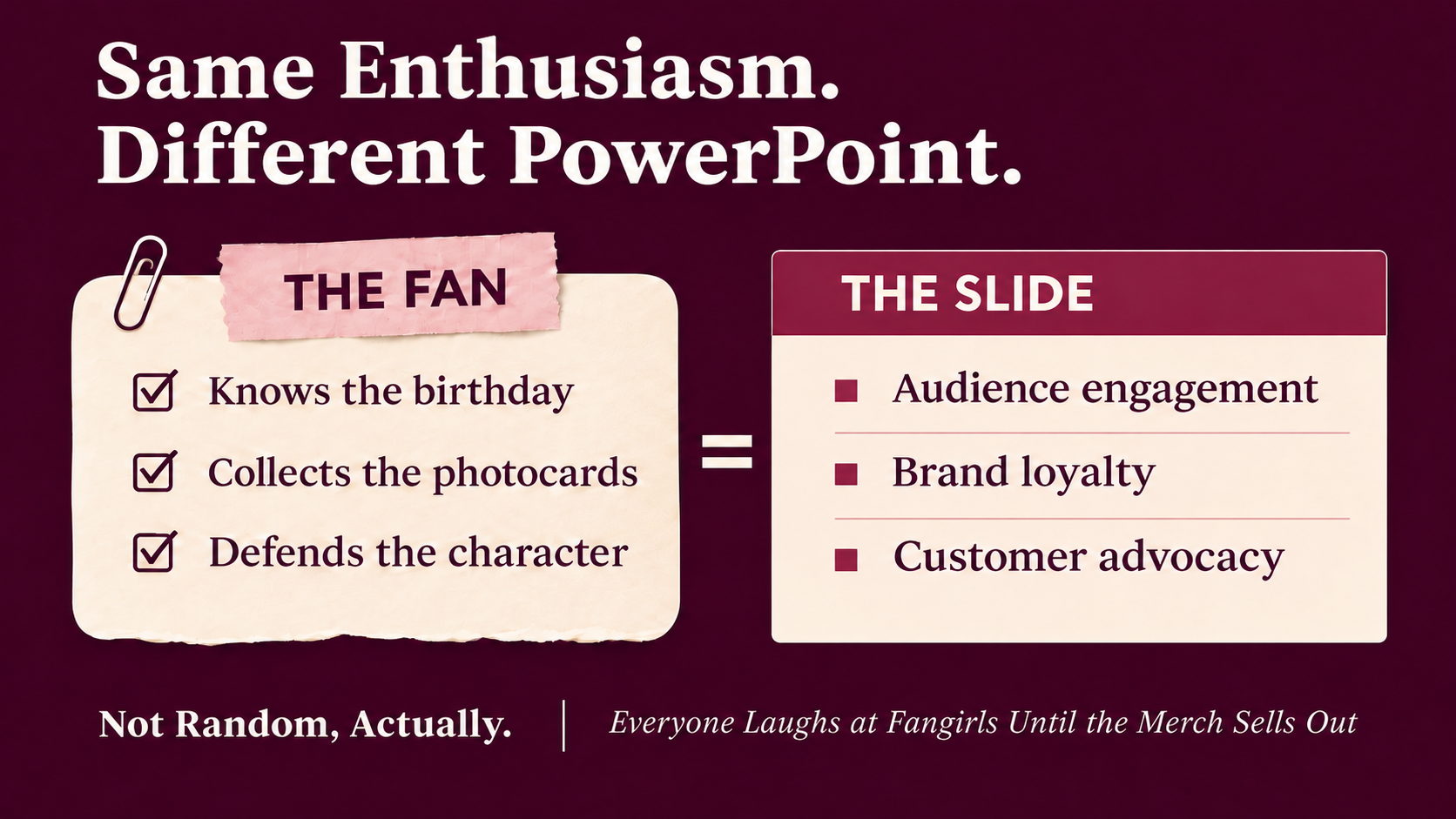
Somewhere on the internet, someone is rolling their eyes at a fan for knowing an artist’s birthday, collecting photocards or defending a fictional character as though they’re on the payroll.
Meanwhile, somewhere in a corporate meeting, a marketing executive is presenting a slide about audience engagement, brand loyalty and customer advocacy.
Same energy. Very different reputations.
I’ve always found that contradiction fascinating. Passionate interests, particularly those associated with fangirls, are often dismissed as frivolous. Researcher Ysabel Gerrard has explored the enduring gendered stereotypes around fandom that portray young, feminine enthusiasm as excessive or embarrassing. Yet businesses invest considerable resources trying to inspire that very devotion.
Of course, fandom isn’t limited to girls. Sports supporters, gamers, book lovers, music fans and so many more can be equally devoted. It just makes me wonder why enthusiasm is sometimes called obsession and other times celebrated as loyalty.
How does something as personal as being a fan become such a powerful force in business, and what happens when companies try to turn that passion into profit?
When Passion Becomes Publicity
Think about what fans actually do.
They don’t just listen to a song, read a book or watch a film. They recommend it, debate theories, create content, introduce friends to it and often keep conversations alive long after the original marketing campaign ends.
Sometimes, fans are doing what companies spend thousands to encourage: attention, participation and phenomenal word of mouth advocacy. Except a recommendation from someone you trust carries credibility that advertising cannot automatically replicate.
Look at “BookTok,” for example. Readers have turned personal recommendations into a major discovery channel. According to sales research shared by TikTok, more than 50 million #BookTok-recommended books were sold across six European markets in 2025.
The influence extends beyond bookstores. Film and television producers are paying attention to online reading communities when considering adaptations, recognizing the value of an existing, engaged audience. Adaptations aren’t new, but fan conversations now offer another visible signal of consumer interest.
The music industry tells a similar story. Taylor Swift’s Eras Tour grossed over US$2 billion. Beyond ticket sales, fans made friendship bracelet exchanges and themed outfits part of the experience, generating demand across industries. Meanwhile, The Weeknd’s After Hours Til Dawn Tour has surpassed US$1 billion by September 2026, further illustrating the commercial scale of passionate music audiences across genres.

A glimpse of BTS’s Arirang concert in Toronto. Photo: Author.
And this devotion isn’t exclusive to music. According to its annual report, Manchester United reported £156.8 million in retail, merchandise, apparel and product-licensing revenue for its 2026 fiscal year.
From concert merchandise to football jerseys, fans aren’t just buying products. They’re expressing their connection, identities, building communities and creating value beyond the purchase itself.
K-Pop, Photocards and an Unexpected Laundry Crisis
K-pop offers a particularly intriguing case study because fandom often extends far beyond music. Albums become collectibles, photocards inspire trading communities, and fans translate interviews, organize projects and introduce artists to people across borders.
Occasionally that influence appears in unexpected places.
In 2019, BTS member Jungkook casually mentioned using his favourite Downy fabric softener during an online fan conversation. Fans became curious, and the product sold out at major online retailers in South Korea. According to the Yonhap News Agency, even Jungkook struggled to buy it afterward.
Imagine casually talking about laundry and accidentally creating a shopping frenzy.
The interesting part? Downy belongs to American company P&G. A South Korean artist’s casual mention sparked unexpected demand for this product in South Korea, showing how fandom can influence purchases across industries and borders without a deliberate or relevant promotion.
But purchases are only part of the greater picture.
Researcher Jasmine Proctor examined how voluntary fan labour such as translating, organizing and circulating content helped artists reach wider audiences.
The commercial side is also substantial. Weverse, an artist and fan platform, reported approximately 370 million fan posts and 20.6 million merchandise items sold through its platform and shop in 2024. These are company reported activity totals, not numbers of individual fans or proof that posting caused purchases.
But numbers alone can’t capture everything fans contribute or what their devotion might cost them. When emotional connection itself becomes the product that businesses profit from, it’s worth asking who truly benefits when belonging is packaged, priced and sold.
For a closer look at the business behind K-pop’s global success, this Bloomberg Originals documentary explores the industry’s strategies, growth and challenges.
Here’s Where My Business-Student Brain Takes Over
It’s tempting to see millions of views, endless queues or sold out merchandise and declare the marketing a success. But attention doesn’t guarantee loyalty, sell-outs don’t necessarily mean profit, and viral moments rarely promise lasting demand.
People may watch a video out of interest, dislike or mere curiosity. Even criticism can generate publicity, which is why understanding how engagement is measured matters.
According to Luminate’s 2024 Music Year-End Report, 73% of surveyed U.S. music superfans purchased physical merchandise, compared with 26% of music listeners overall. Similarly, 81% discussed artists with friends or family, compared with 41% overall.
These figures highlight how purchasing and word of mouth activity are associated with highly engaged audiences. However, because Luminate’s definition of a superfan partly includes these behaviours, these figures reflect patterns of fan engagement rather than independently proving that fandom causes additional spending.
In other words, treating every devoted fan as a guaranteed high spender risks turning insight into wishful thinking. And that’s where things get even more interesting from a business perspective.
If a product sells out after an artist mentions it, how much of that demand can we reasonably attribute to the mention? Would customers have discovered it otherwise? Will they return after the initial excitement? And will the additional revenue justify the costs?
For me, that’s where marketing, analytics and finance intersect: understanding how fandom influences consumer behaviour, whether it creates durable demand, and whether the financial returns justify the costs.
The Value That Doesn’t Fit Neatly Into a Spreadsheet
Not everything valuable about fandom shows up in numbers. Fans are creators, translators, advocates and critics, who are also sometimes the first to challenge a company when its decisions threaten the brand image they helped build.
That independence is important, especially when businesses benefit from emotional attachment.
Limited editions, paid memberships, exclusive experiences and collectibles can enhance the fan experience. But they can also create pressure to keep spending just to feel included.
Researchers Grant Bollmer and Bethany Tillerson examine related tensions in their platform fandom study, exploring how fan platforms shape relationships while linking participation with commercial opportunities. On the other hand, a fandom’s influence isn’t always positive either as the same passion that drives advocacy can also fuel harassment, exclusion and spending pressure.
That doesn’t mean fandom is inherently unhealthy or businesses are wrongly exploiting profit from it. But it raises an important question. Are businesses creating something valuable with their communities, or simply becoming better at extracting value from them?
The problem begins when businesses make belonging feel scarce, competitive, or purchasable. After all, fans shouldn’t always have to keep buying things to prove their loyalty, and businesses shouldn’t mistake profiting from that loyalty for owning it.
What Can Brands Learn From Fangirls?
The lesson lies in understanding what makes people care enough to recommend, return and bring others along.
Why do readers discuss fictional worlds years after the final chapter? Why do football fans remain loyal through disappointing seasons? Why do music fans introduce strangers to their favourite artists? The list goes on and the answer is often a combination of identity, trust and shared experiences.
For businesses, effective fandom marketing starts with understanding the communities behind brand loyalty. By listening to fans, encouraging participation, and giving people reasons to remain engaged, brands have a better chance of turning initial enthusiasm into lasting relationships and value.
And perhaps there’s something for the rest of us to reconsider, too.
When a fangirl studies every detail of an artist’s comeback, some call it obsession. When a company studies every detail of its customers, it’s called market research.
Maybe the interesting question isn’t why fangirls care so much. It’s why businesses invest so heavily trying to inspire the very passion we sometimes dismiss.
Your turn: What’s something you’re passionate about that others dismiss as “too much”? I’d love to hear your thoughts in the comments.
This article reflects my perspective on fandom and its business implications informed by cited research, industry reports and real-world examples.
At Not Random, Actually, I explore unexpected connections between culture, markets, data and everyday life. Learn more about me and my work on my About page.


Leave a Reply