On digital friendships, the business of sharing, and the advice we never asked for.
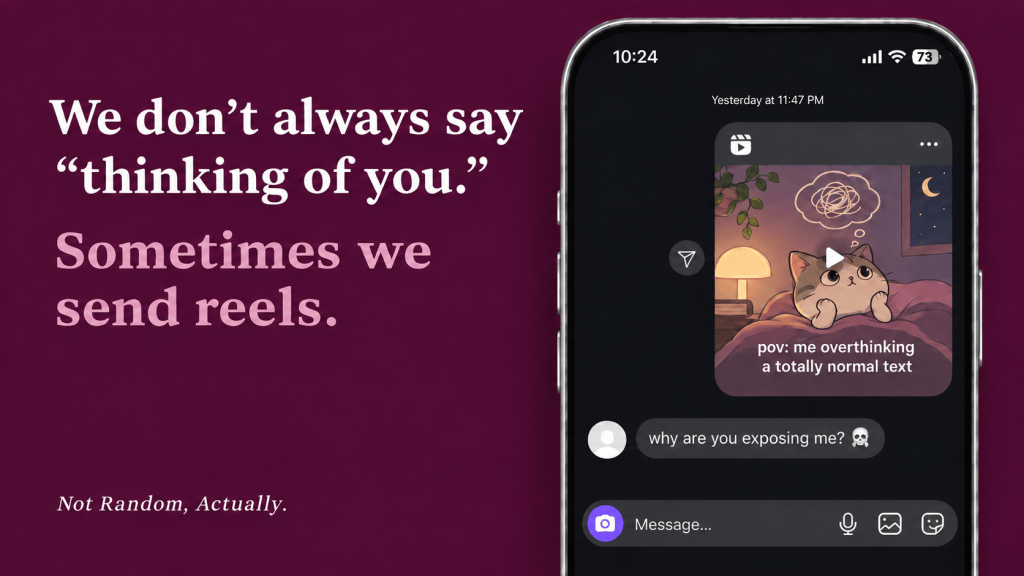
An illustrative recreation of a real reel-sharing exchange.
There’s a particular kind of friendship where you can go an entire day without saying hello, yet somehow exchange fifteen reels and feel very connected.
A cat with an attitude problem. A painfully accurate joke. Something so specific you wonder whether the algorithm knows your friend better than you do.
And somewhere between the memes and the questionable humour, a conversation has happened.
No elaborate message. Sometimes not even a caption.
Just: This is so you lol.
It’s funny to think that people once sent messages by carrier pigeons and now we are just a click away.
When Sharing Becomes a Love Language
I’ve always found it interesting how something as ordinary as forwarding a video can feel surprisingly personal. Of everything someone could have scrolled past, one thing reminded them of you.
A joke says Remember us? A sentimental clip, I miss you. Something ridiculous at 2 a.m.? I found this, and now it’s your problem.
Of course, not every reel carries a profound message. Sometimes a dancing potato is just a dancing potato. But connection doesn’t always need a grand gesture.
In a study of young adult TikTok users in the UK, researcher Andreas Schellewald explored how sharing short videos can help maintain relationships and communication because sometimes more than the message, it’s about who sends it.
And often, that video is just the beginning. Group chats jump from memes to unexpectedly serious debates so easily that “we should start a podcast” becomes a recurring suggestion among close friends everywhere.
Friendship And The Marketing Machine
Here’s where my business student brain kicks in.
In September 2025, Meta reported over 4.5 billion daily reel reshares across its platforms. Those are shares, not unique people or proof of meaningful friendships. But they form an enormous distribution network worth examining.
Think about the journey. An algorithm recommends a video. Someone shares it. They react, talk, perhaps pass it along. The original creator may never see those private conversations, yet these actions help the content travel.
These interactions also adds financial value to platforms such as Meta, which reported over US$196 billion in advertising revenue in 2025, though this figure isn’t specifically from shared reels.
To us, it’s a friendship ritual. To a creator, it’s potential reach. To a platform, it’s engagement where the same share button is both a distribution tool and a social gesture.
This overlap between personal connection and commercial value also appears in my article on the business of fandom and belonging.
Five Friends, Or Five Reels?
But what I find more complicated is the endless stream of readily available advice on almost everything, from what to eat and buy to how to live, love, and romanticize everyday life.
One reel tells you to cut people off and protect your peace. The next urges you to fight for your relationships. One calls silence maturity while another calls it emotional avoidance. All delivered with remarkable confidence that might slowly get ingrained in the way we think and feel.
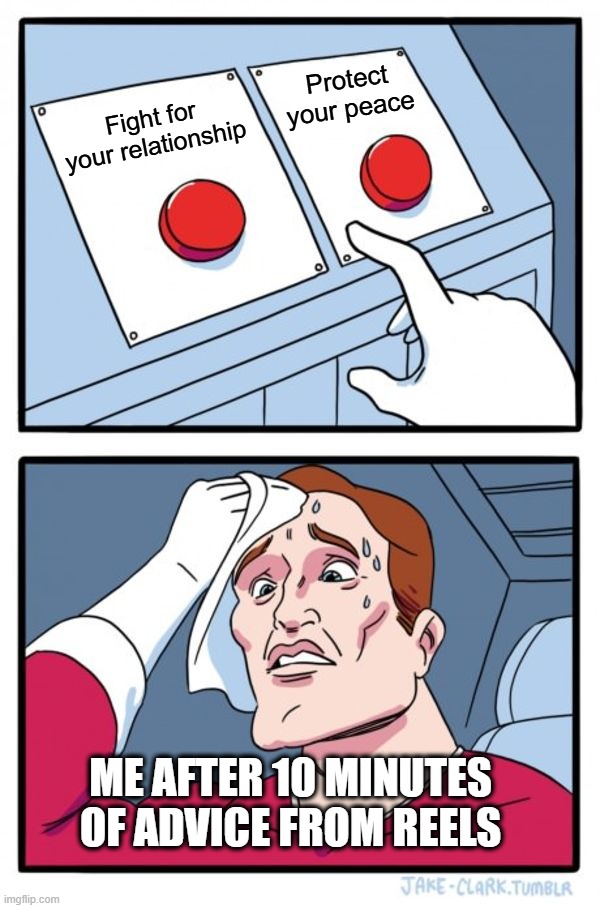
There’s a famous saying: “You are the average of the five people you spend the most time with.” But when we spend so much time scrolling and consuming content, perhaps it’s now worth asking: how much influence do the last five reels we watched have on us?
DataReportal’s Digital 2026 report estimates that online adults spend an average of 18 hours and 36 minutes weekly on social and video feeds.
That doesn’t mean we believe everything we watch or that all advice is inherently bad. Rather, sometimes reels can offer knowledge that we couldn’t have gained easily otherwise. Still, that’s a considerable amount of time spent listening to voices that don’t necessarily know us back.
It’s not that these reels can rewrite our personalities. But when the same advice keeps appearing, how often do we mistake that familiarity for wisdom or treating it as the norm?
Meta explains that our activity helps shape its content recommendations. So the joke I built my feed brick by brick is kind of true. We choose some bricks while the algorithm lays others.
This makes me wonder whether even emotional intelligence is becoming another neatly packaged product that can be sold. Some advice genuinely helps us understand our feelings. But empathy isn’t a script, and a thirty-second video can’t know every side of someone’s story.
So perhaps the deeper issue may not be how much we scroll, but how easily we allow confident advice online to overshadow our own judgement and how quickly we start borrowing personalities that feel inauthentic to us.
Besides shaping how we think, social media can also influence how we connect. In this Big Think video, Harvard professor Arthur Brooks explores why social media may work better as a complement to friendships than a substitute for time together.
Beyond the Share Button
People have always found little ways to say this reminded me of you. Postcards, newspaper clippings, book and song recommendations. Now, sometimes it’s just a reel on a dog making spectacularly poor decisions.
The format has changed but the impulse behind it feels familiar.
A shared joke can keep a friendship warm by reminding someone that they are known and remembered, but it can’t always replace the deep conversations that require more courage and time.
We can exchange reels all day and still leave the important things unsaid and unheard.
Maybe the balance lies in letting what we watch spark questions rather than dictate answers, and in having open conversations that bridge loneliness and distance. And sometimes, genuine connection requires more than just a share button.
Because a reel can say I thought of you.
But it cannot sit with you in the silence that follows: How are you, really?
Your turn: What’s the most oddly specific reel someone sent you that made you feel completely understood? I’d love to hear about it in the comments below.
This article reflects my perspective on digital friendships and social media, informed by cited research and personal observations. The sources provide context rather than definitive conclusions about how sharing reels affect friendships and other relationships.
At Not Random, Actually, I explore unexpected connections between culture, markets, data and everyday life. Learn more about me and my work on my About page.


What are your thoughts on this?